Refrigerant Lines On The Mechanically-Powered A/C Compressor, Connecting And Disconnecting: Removing
-- Discharge the refrigerant circuit. Refer to REFRIGERANT CIRCUIT, DISCHARGING WITH A/C SERVICE STATION (R134a) / REFRIGERANT CIRCUIT, EVACUATING WITH A/C SERVICE STATION (R134a) / REFRIGERANT CIRCUIT, CHARGING WITH A/C SERVICE STATION (R134a) (Refrigerant R134a Servicing, Refrigerant Circuit, Working with A/C Service Station) or REFRIGERANT CIRCUIT, DISCHARGING (R1234yf) / REFRIGERANT CIRCUIT, EVACUATING (R1234yf) / REFRIGERANT CIRCUIT, CHARGING (R1234yf) .
-- Remove the air guide from the lock carrier. Refer to OVERVIEW - LOCK CARRIER / RADIATOR AIR DUCT, REMOVING AND INSTALLING (vehicles with a diesel engine) or AIR FILTER HOUSING, REMOVING AND INSTALLING [CNSB, CNTC] (vehicles with a diesel engine).
-- If necessary, remove the front noise insulation. Refer to NOISE INSULATION, REMOVING AND INSTALLING / OVERVIEW - NOISE INSULATION .
Continuation For Audi RS3 Version 1:
-- Remove the bolts -arrow-.
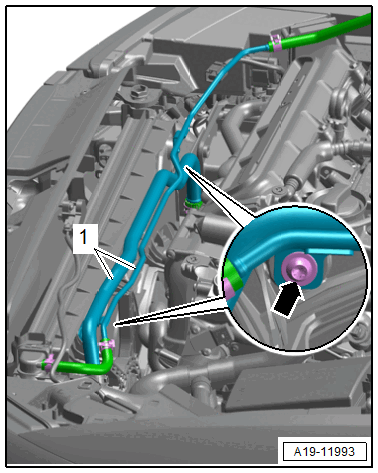
-- Push the coolant pipe and coolant line -1- slightly to the rear.
Continuation For Audi RS3 Version 2:
-- If necessary, loosen the coolant hoses -1- from the bracket and carefully push toward the rear.
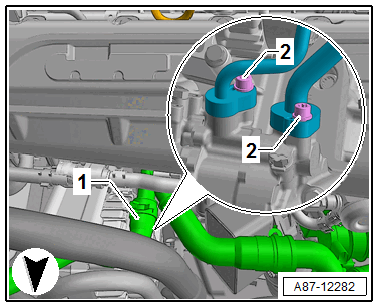
-- Remove the bolts -2- (for example using the : 3320/1 ).
-- Remove the refrigerant lines.
Continuation For All Vehicles:

Risk Of Damaging The Refrigerant Lines And Hoses.
- Do not bend, twist or stretch the refrigerant lines and hoses.
Danger Due To Refrigerant Coming Out Under Pressure.
Danger of frost bite to skin and other parts of the body.
- Evacuate the refrigerant and immediately open the refrigerant circuit afterward.
- If more than 10 minutes have elapsed since evacuating the refrigerant and the refrigerant circuit was not opened, evacuate the refrigerant again. Pressure in the refrigerant circuit is caused by evaporation.
-- Remove the bolts -2 and 4- using the :3320/1 and remove the refrigerant lines -1 and 3-.
-- Seal the open lines and connections with clean plugs from the :VAS6122 .
Risk of destroying the A/C compressor.
- The A/C compressor is always driven when the engine is running; there is no A/C clutch. Therefore the engine may only be started when the refrigerant circuit has been properly assembled.
- For example, if the refrigerant lines are not connected to A/C compressor and the connections are sealed, the A/C compressor may heat up so much when the engine is running that the A/C compressor will be destroyed by internal heat generation.